Battle of Ideas Festival Audio Archive
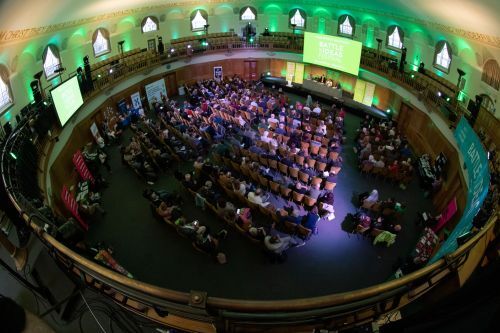
The Battle of Ideas festival has been running since 2005, offering a space for high-level, thought-provoking public debate. The festival’s motto is FREE SPEECH ALLOWED. This archive is an opportunity to bring together recordings of debates from across the festival’s history, offering a wealth of ideas to enjoyed. The archive also acts as a historical record that will be invaluable in understanding both the issues and concerns of earlier years and the ways in which debates have evolved over time.
Listen on:

Episodes

Feb 11, 2026
Feb 11, 2026
15 min
Recorded at the Battle of Ideas festival 2025 at Church House and the Abbey Centre, Westminster, on Saturday 18 October.
ORIGINAL INTRODUCTION
The twentieth annual Battle of Ideas festival opened with a Welcome Address.
SPEAKERS
Ben Deloentrepreneur, mathematician and philanthropist
Alastair Donaldco-convenor, Battle of Ideas festival; convenor, Living Freedom; organiser, European Free Speech Network
CHAIRClaire Foxdirector, Academy of Ideas; independent peer, House of Lords; author, I STILL Find That Offensive!
Apr 3, 2025
Apr 3, 2025
1hr 5 min
Recorded at the Buxton Battle of Ideas festival 2022 on Saturday 5 November at Devonshire Dome, Buxton.
ORIGINAL INTRODUCTION
During the pandemic, the government launched a policy paper, Build Back Better: Our Plan for Growth, ‘setting out the government’s plans to support economic growth through significant investment in infrastructure, skills and innovation’. In his foreword, the then prime minister, Boris Johnson, declared that ‘we must grasp the historic opportunity before us: to learn the lessons of this awful pandemic and build back better, levelling up across our United Kingdom and fixing the problems that have held back too many people for too long’.
Yet from housing to airports, power stations to reservoirs, it seems difficult, if not impossible, to build very much at all. Any sort of development is met with resistance from people accused of being NIMBYs (Not In My Back Yard). In short, even if those people think that a particular development is a good idea in principle, they don’t want it to be too close to where they live. And with MPs unwilling to upset constituents, this seems to be a powerful lobby.
But while NIMBYs are a long-standing problem, another kind of objection is from environmentalists who seek to hold the government to its promise of ‘Net Zero’ greenhouse-gas emissions by 2050. If we are to eliminate emissions and ‘save the planet’, then anything from fracking to an extra runway can be called into question.
Even when major infrastructure works do get the go-ahead, they seem routinely beset by delays. Work on London’s Elizabeth Line started in 2009, but the core section only opened in May 2022. The high-speed rail line between London and northern England – HS2 – is still years behind schedule, truncated and massively over budget. Even maintaining infrastructure seems difficult, with news that Doncaster Sheffield Airport is threatened with closure.
If we really want plentiful, affordable housing, modern infrastructure and a thriving economy, what are the barriers to be overcome? How can we ‘build back better’?
SPEAKERSSimon Cookeurbanist; former regeneration portfolio holder and leader of the Conservative group, Bradford City Council
Rosamund Cuckstonsenior HR professional; co-organiser, Birmingham Salon
Dr Caspar Hewettlecturer and degree programme director, Water Group, EuroAquae+, School of Engineering, Newcastle University; director, The Great Debate
Gawain Towlerconsultant; former director of communications, Brexit Party
CHAIRAustin Williamssenior lecturer, Dept of Architecture, Kingston University, London; honorary research fellow, XJTLU, Suzhou, China; author, China’s Urban Revolution: understanding Chinese eco-cities
Apr 3, 2025
Apr 3, 2025
42 min
Recorded at the Battle of Ideas festival 2022 on Sunday 16 October at Church House, Westminster.
ORIGINAL INTRODUCTION
Over the past two decades, there have been enormous controversies around science issues. Genetically modified foods were described as ‘Frankenfoods’ in the press. The ‘Climategate’ email leak created a storm about the honesty and integrity of climate scientists. Then there was the time the government sacked its own science advisor, David Nutt, for challenging drug laws.
Fiona Fox has been at the centre of all of this. In 2001, she became the founding director of the Science Media Centre, Britain’s independent press office for science. Now she has now written a book, Beyond the Hype: the inside story of science’s biggest media controversies. Published in April 2022, the book is part memoir of the first 20 years of the SMC, part manifesto for change – particularly the urgent need to separate communication of scientific research from government communications.
What can we learn from these furores about science? Who is to blame when science is distorted? How can we foster a better understanding of science, particularly when science is at the centre of big political debates?
SPEAKERFiona Foxchief executive and founding director, Science Media Centre; author, Beyond The Hype: the inside story on science's biggest controversies
CHAIRMax Sandersoneditor of weekly podcasts, Guardian
Apr 3, 2025
Apr 3, 2025
1hr 16 min
Recorded at the Battle of Ideas festival 2022 on Sunday 16 October at Church House, Westminster.
ORIGINAL INTRODUCTION
If once sex education meant ensuring pupils were given access to basic biology and the mechanical details of reproduction, today it has become mired in the non-biological Culture Wars.
In September 2020, sex education was made compulsory across secondary schools. Pupils from primary onwards are asked to grapple with sensitive and often controversial topics such as sexuality, intimate interpersonal relationships, consent and, most controversially, gender identity as quite distinct from biology. Many head teachers have sought outside help from external agencies to provide teaching materials, staff training and workshops to pupils, providing what some see as a trojan horse for gender activism into schools.
Shocking stories have emerged from classrooms: discussions on masturbation with children as young as five, LGBTQ+ concepts – from queer to kink – normalised on the curriculum, key words introduced to children as young as eight, including cisgender, pansexual, asexual, intersex, non-binary and gender fluid. The fear that children are being exposed to over-sexualised concepts has been stoked-up by schools introducing Drag Queen Story Hour, in which men dressed as women read stories and perform to children aged from three to 12.
But are all these concerns just a moral panic, driven by conservative – even prejudiced – parents and right-wing culture warriors? In a world in which increasing numbers of young people are exploring their gender identity, won’t new RSE lessons help new generations negotiate modern sexual norms? Or is the safeguarding of children being compromised in the enthusiasm to promote equality, diversity and inclusion ideology?
Get your tickets to the 2022 Battle of Ideas festival here.
SPEAKERSRyan Christopherdirector, ADF UK; co-founder, Humanum Institute; public speaker
Stephanie Davies-Araidirector, Transgender Trend; author, Communicating with Kids
Milli Hillfreelance journalist; founder, Positive Birth Movement; author, Positive Birth Book
Josephine Husseyschool teacher
CHAIRAnn Furediauthor, The Moral Case for Abortion; former chief executive, BPAS
Apr 3, 2025
Apr 3, 2025
1hr 22 min
Recorded at the Battle of Ideas festival 2022 on Saturday 15 October at Church House, Westminster.
ORIGINAL INTRODUCTION
This year, the Battle of Ideas Balloon Debate tackles the greatest ever protest song.
Six participants will argue for their choice, in a light-hearted debate with a serious intent. Audience participation encourages you to agree, disagree, challenge, assess and dismiss those arguments and the songs that you think strike a bum note.
The panel will have a few minutes only to convince you of their choice. Could it be a Platinum Jubilee victory for the Sex Pistols, or will this finally be the year to ‘Give Peace a Chance’? Does the appeal of Bruce Springsteen’s ‘Born in the USA’ to Democrats and Republicans alike mean it’s an agitprop hit or a dud? Are you more Billie Holiday or NWA? This balloon debate will be informative and fun. There will be outrage as apparent frontrunners slide down the charts and less-obvious challengers make a charge for Number One.
The discussion allows just five minutes for each panelist’s defence before you, the audience, takes them to task. You can challenge or reinforce their choice. The audience then votes to chuck three contenders out of the virtual balloon before the remaining candidates make a final plea for your vote. Who knows, we might even ask the winner to lead us all in Battle-style karaoke singalong of the winning song!
SPEAKERSEmma Burnellfounder and political consultant, Political Human; journalist; playwright, No Cure For Love and Triggered
Tom Collyermusician; writer; assistant programmer, Battle of Ideas festival; sailing coach; alumnus, Debating Matters
Neil Davenportcultural critic; head of faculty of social sciences, JFS Sixth Form Centre
Brian Dennytrade-union journalist, Rebuild Britain; author, Rebuild Britain’s Fishing Industry; curator, Working River: songs and music of the Thames project
Ralph Leonardauthor, Unshackling Intimacy: Letters on Liberty; contributor, Areo
Winston Marshallmusician; writer; podcast host, Marshall Matters; founding member, Mumford & Sons
Joel Millsacting director for music, British Council ; former programmer, The Spitz
Ali Mirajcolumnist, TheArticle; founder, the Contrarian Prize; infrastructure financier; DJ
CHAIRDavid Bowdenassociate fellow, Academy of Ideas
Apr 3, 2025
Apr 3, 2025
44 min
Recorded at the Battle of Ideas festival 2022 on Sunday 16 October at Church House, Westminster.
ORIGINAL INTRODUCTION
From Banksy to Extinction Rebellion, artivism (activism through art) is the art of our era. From international biennale to newspaper pages, artivism is everywhere. Both inside museums and on the streets, global artivism spreads political messages and raises social issues, capturing attention with shocking protests and weird stunts.
The inclusion of political messages in works of art is nothing new – Picasso’s 1937 work Guernica is both aesthetically daring and politically loaded with anti-war messaging. Neither is it novel for art to become part of political campaigns – from Emory Douglas’ prints used by the Black Panther movement to Alberto Korda’s photo of Che Guevara adorning every rebellious teen’s bedroom wall. But a more contemporary artivism – explicit use of artistic mediums for political protest, like feminist works by Guerrilla Girls or indeed the destruction of art by Just Stop Oil protesters in museums – raises a new set of questions.
Is this fusion of art and activism all it seems? Are artivist messages as subversive and anti-authoritarian we assume they are? How has the art trade commodified protest and how have activists parasitised art venues? And is artivism actually an arm of the establishment?
Using artist statements, theoretical writings, statistical data, historical analysis and insider testimony, British art critic Alexander Adams examines the origins, aims and spread of artivism in his latest book, Artivism: the battle for museums in the era of postmodernism. In it, he argues that there are troubling ethical infractions within public organisations, and a culture of complacent self-congratulation in the arts. His findings suggest the perception of artivism – the most influential art practice of the 21st century – as a grassroots humanitarian movement could not be more misleading.
Join Alexander and art critic JJ Charlesworth for this lunchtime discussion about artivism and the future of the art world.
SPEAKERSAlexander Adamsartist, writer and art critic; author, Culture War and Artivism: the battle for museums in the era of postmodernism
CHAIRJJ Charlesworthart critic; editor, ArtReview
Apr 3, 2025
Apr 3, 2025
1hr 33 min
Recorded at the Battle of Ideas festival 2022 on Saturday 15 October at Church House, Westminster.
ORIGINAL INTRODUCTION
The war between the generations has never felt stronger. Your age supposedly determines how you vote, your views on the world and your prospects for the future. Older people decry younger citizens as ‘woke snowflakes’, while the young in turn dismiss their parents as stealing their future via Brexit, climate change and house prices. As 50 per cent of young people – for now – attend university, generational attitudes towards free speech and pluralism have also come under strain.
When it comes to financial matters, it’s easy to see the insecure employment and housing market as proof that young people’s prospects are bleak. On the other hand, many argue that young people have never had it so good, enjoying more opportunities and innovation than any previous generation. Today’s young generation are more likely to own cars, go on foreign holidays and eat in restaurants than their parents or grandparents.
So is this really a generation war? Or does class still create a greater dividing line? After all, economic struggle is not unique to today’s youngsters. And whether it’s owning a home or being able to afford avocado on toast, what are the prospects, hopes and dreams for young people in the 2020s?
SPEAKERSEmily Carveracting director of communications and head of media, Institute of Economic Affairs
Ceri Dingledirector, WORLDwrite and WORLDbytes
Kunle Olulodedirector, Voice4Change England
Sam ParkerEuropean financial regulation specialist; former parliamentary assistant, European Parliament and House of Lords
Freddie Poserdirector, PricedOut
CHAIRNoah Keatejournalist and writer
Apr 3, 2025
Apr 3, 2025
1hr 31 min
Recorded at the Battle of Ideas festival 2022 on Sunday 16 October at Church House, Westminster.
ORIGINAL INTRODUCTION
Over the summer, the OCR exam board announced it has replaced literary giants Philip Larkin, Seamus Heaney and Wilfred Owen from its English syllabus in favour of ‘exciting and diverse’ ‘poets of colour’ and ‘disabled and LGBTQ+ voices’. The then education secretary, Nadhim Zahawi, denounced OCR’s changes as ‘cultural vandalism’.
The decision fed widespread parental concern that schools are becoming a hotbed of political activism, their children indoctrinated by biased teachers and curricula as likely to espouse social-justice ideology as passing on ‘the best which has been thought and said’.
However, some argue this narrative of politicised teaching is a caricature, itself a political act of dragging schools into the Culture Wars. The NEU’S Dr Mary Bousted warns that politicians’ hype about impartiality could induce such uncertainty and caution in schools about ‘political issues’ that students will be ‘denied the opportunity to engage with the most challenging issues of our time’, including racism and climate change.
Can contested political ideas be dealt with in classrooms via viewpoint diversity or should schools steer clear of tackling political controversies altogether? Are pupils to be viewed as a captive audience, too young to challenge what they’re hearing, or young people who need to be engaged with contemporary social trends?
SPEAKERSDr Deborah Haytonteacher; trade unionist; contributor, Spectator, Unherd and other publications
Dr Sean Langsenior lecturer in History, Anglia Ruskin University; author, First World War for Dummies and What History Do We Need?; fellow, Historical Association
Dr Alka Sehgal Cuthbertdirector, Don't Divide Us; author, What should schools teach? Disciplines, subjects and the pursuit of truth
Emma Webbdirector, Common Sense Society, UK branch; host, Newspeak; commentator; writer; co-founder, Save Our Statues
CHAIRGareth Sturdyphysics advisor, Up Learn; education and science writer
Apr 3, 2025
Apr 3, 2025
46 min
Recorded at the Battle of Ideas festival 2022 on Sunday 16 October at Church House, Westminster.
ORIGINAL INTRODUCTION
December 2022 marks the 50th anniversary of the last Apollo moon mission, Apollo 17. At that time, space exploration was a near-duopoly between the USA and USSR. Since then, it has been confined to unmanned probes or manned research projects, most notably the International Space Station. NASA’s plan to get humans back to the Moon had a false start with the postponement of August’s Artemis I launch.
In recent years, there have been multiple new national players on the scene. China first put a man into space in 2003 and has been putting in place the components of its own large modular space station, Tiangong-3, since 2021. India has launched unmanned missions to the Moon and plans to put a lander there in 2023. Dozens of countries, from Algeria to Vietnam, now operate satellites.
There has also been a proliferation of private companies working in space – including firms like Elon Musk’s SpaceX, Jeff Bezos’s Blue Origin and Richard Branson’s Virgin Galactic that aim to offer civilian tourist flights. Musk’s Starlink satellite communications service has also played a crucial role in communications during the war in Ukraine.
What is the future for our use of space? Will manned missions beyond Earth’s orbit make a comeback any time soon? And is regulation possible or desirable – or has the Final Frontier become the new Wild West?
SPEAKERSIan Crawfordprofessor of planetary science and astrobiology, Birkbeck College, University of London
Dr Norman Lewisdirector, Futures-Diagnosis Ltd; co-author, Big Potatoes: the London manifesto for innovation
Thomas Walker-Werthfellow and editor, Objective Standard Institute; co-host, Innovation Celebration
CHAIRDr Paul Reevesdeveloper of Manufacturing Simulation Technology
Apr 3, 2025
Apr 3, 2025
1hr 14 min
Recorded at the Battle of Ideas festival 2022 on Sunday 16 October at Church House, Westminster.
ORIGINAL INTRODUCTION
The Queen’s Platinum Jubilee led to renewed speculation about the future of the Commonwealth and her death will only add to the questions about the Commonwealth’s future. Regarded by many as her most significant achievement, the organisation’s role in levelling sanctions against South Africa in 1986 was said to play a key role in the end of Apartheid by its supporters.
But today, there are increasing accusations that the Commonwealth is an anachronism and an irrelevance. Despite attempts to put it at the heart of post-Brexit Britain, it is unclear what this means beyond a slogan. Furthermore, some Commonwealth countries have either removed or questioned the British monarchy as their head of state. The royals’ role in the organisation has been questioned too, with Prince William even suggesting that it didn’t need to have a member of the royal family at its head.
Yet, many see in these developments the seeds of a renewed and strengthened Commonwealth. If countries can become republics but still want to stay in, as some Caribbean countries have, does this point to the enduring strengths of the organisation? After all, it remains the key – perhaps only – institution where less powerful nations can attempt to influence global affairs. With this in mind, even several Francophone countries, like Gabon or Togo, have begun to join.
When many countries are more likely to demand reparations from the British monarchy rather than bow in deference, is there any role for the Commonwealth today? Can it be a useful platform for smaller nations to influence global affairs, or is it simply outdated?
SPEAKERSTessa Clarkejournalist; author; documentary reporter
Dr Rakib Ehsanauthor, Beyond Grievance: what the Left gets wrong about ethnic minorities
Lord Howellpresident, the All-Party Commonwealth Parliamentary Group; politician; journalist; economic consultant and author
Jonathan McClorypartner, Sanctuary Counsel; expert on soft power, public diplomacy and foreign affairs; creator, partner, The Soft Power 30
CHAIRDr Mo Lovattnational coordinator, Debating Matters; programme coordinator, Academy of Ideas
Apr 2, 2025
Apr 2, 2025
45 min
Recorded at the Battle of Ideas festival 2024 on Saturday 19 October at Church House, Westminster.
ORIGINAL INTRODUCTION
In many ways, we seem to live our lives according to the output of algorithms. They determine the suggestions for the next thing to watch on Netflix and the next thing to buy on Amazon. Our social-media timelines throw up posts that algorithms deem to popular or likely to be of particular interest to us – there are claims this process stoked the summer riots in the UK – along with a side order of personalised adverts. One way or another, algorithms are blamed for many of society’s ills.
Yet an algorithm is simply a well-defined and self-contained procedure, made up of a finite number of ordered steps, to be carried out in order to solve a problem or complete a task. With the twentieth-century advent of computer science, and twenty-first-century developments in Big Data and AI, algorithms have become invisibly woven into countless aspects of our world and our lives. Rarely, however, do we pause to reflect on where algorithms come from and what they tell us about ourselves.
Algorithms are often thought of as a recent phenomenon, but their history can be traced back 4,000 years or more. This history takes us from the First Babylonian Empire, to ancient Alexandria, to Baghdad in the Islamic Golden Age, to nineteenth- and twentieth-century breakthroughs in Königsberg, Göttingen, Vienna, Cambridge and Princeton.
Over the course of their history, algorithms have proved to be an increasingly useful and powerful tool, while confronting humanity with an unsettling question – can all intellectual endeavour be explained, and pursued, in terms of algorithms? Answers to this question, once discovered, gave birth to the rich field of computer science. However, these answers were themselves strange and unsettling, and have been cast in new light by subsequent developments.
In this lecture, Sandy Starr will explore the history of algorithms, and explain how this history can help us think through the challenges posed by today’s AI.
SPEAKERSSandy Starrdeputy director, Progress Educational Trust; author, AI: Separating Man from Machine
CHAIRHarley Richardsonchief product officer, OxEd and Assessment; organiser, AoI Education Forum; blogger, historyofeducation.net; author, The Liberating Power of Education
Apr 2, 2025
Apr 2, 2025
1hr 32 min
Recorded at the Battle of Ideas festival 2024 on Saturday 19 October at Church House, Westminster.
ORIGINAL INTRODUCTION
‘Labour will introduce a landmark Race Equality Act, to enshrine in law the full right to equal pay for Black, Asian, and other ethnic minority people, strengthen protections against dual discrimination and root out other racial inequalities.’ This is the promise given in Labour’s election manifesto. It all sounds sensible enough at a quick glance – surely any legislation that creates a fairer and more equal society should be welcomed? After the summer riots, UK race relations feel fragile. The question is, will Labour’s promised new laws help or hinder community cohesion?
Some fear the law might be both unnecessary and, worse, could create unnecessary dividing lines, encouraging a racialised view of everyday life. For example, Labour wants to make it mandatory for large companies to report on pay gaps according to ethnicity, bringing it into line with reporting on gaps between men and women’s pay. But is this legislation really necessary, when it is already illegal to pay people less on the basis of their ethnicity? A report from EU Agency for Fundamental Rights even ranks Britain the lowest in terms of prevalence of discrimination due to ethnic background. Moreover, as Lord Sewell’s Report for the Commission of Racial and Ethnic Disparities pointed out, comparing men to women, who each make up about half the population, is more reliable statistically than comparisons between many different, mostly smaller ethnic groups.
The proposed Bill also risks embroiling schools in controversy over reporting on ethnic disparities in outcomes, with vague promises of a ‘curriculum which is rich and broad, inclusive and innovative’. Indeed, some critics have interpreted this as code for rejecting established educational standards and practices in favour of more politicised EDI material entering the classroom. Additionally, promises to reverse the Conservatives’ decision to downgrade the monitoring of anti-Semitic and Islamophobic hate – which potentially means adopting the All-Party Parliamentary Group’s definition of Islamophobia – compounds fears that, rather than progressing equality, a new race-relations law might fuel even more division.
Why does the Labour Party think British people need more law to improve race relations via eliminating disparities? Is disparity proof of inequality? Might proposed Positive Action schemes create new divisions and resentment in workplaces and schools? Or is the law a well-meaning and important stepping stone in ensuring a cohesive society, with all possible vestiges of racism removed from the public square?
SPEAKERSAlbie Amankonabroadcaster; financial analyst; executive member, 2022 Group; vice chair of outreach, LGBT+ Conservatives; co-founder, Conservatives Against Racism
Dr Anna Loutfibarrister, The Barrister Group; managing partner, DL Law; advisory council member, Don’t Divide Us
Hardeep Singhjournalist, author, ‘Islamophobia’ Revisited; deputy director, Network of Sikh Organisations
Colin Wynter KCmulti-award winning barrister, Maryon Wynter Chambers;
CHAIRDr Alka Sehgal Cuthbertdirector, Don't Divide Us; author, What Should Schools Teach? Disciplines, subjects and the pursuit of truth
Apr 2, 2025
Apr 2, 2025
47 min
Recorded at the Battle of Ideas festival 2024 on Sunday 20 October at Church House, Westminster.
ORIGINAL INTRODUCTION
From the introspection of his solo cello suites to the grand drama of his choral works, Johann Sebastian Bach is one of the musical greats – uniting technical mastery with a profound understanding of musical form and structure. Although exceptionally talented, his real genius lay in his ability to synthesise tradition with innovation, to create music not merely mathematically precise, but capable of expressing the full cosmos of human emotion.
But, in this year, the 300th anniversary of the premiere of Bach’s St John Passion, does this godlike figure of classical music still matter? Alas, it seems, even among music scholars, he is no longer considered a Titan. In some academic circles, the fact that Bach was a heterosexual white male makes him merely an irrelevance – and even offensive to modern sensibilities.
For example, take a pivotal scene in the Hollywood film Tár, in which self-declared ‘BIPOC, pangender’ music student Max says that Bach’s reputation for misogyny and cisgender-white-maleness make it hard for him to appreciate the composer’s music. Lydia Tár, the fictional conductor of an orchestra in Berlin and masterclass tutor at Julliard, suggests students should focus on the music instead of immutable characteristics. Edited phone footage of her comments becomes a contributing factor in Tár’s eventual cancellation from the heights of classical music fame. The scene seems entirely plausible.
In recent years, other composers of Western classical music have also faced hostile investigation. From claims that music theory is a racial ideology to be dismantled, to suggestions that studying white European music causes students of colour distress, it has become almost impossible in classrooms and peer-reviewed journals to assert the intrinsic value of classical music. In a bid to ‘decolonise’ the music curriculum, an Oxford professor branded musical notation itself ‘colonialist’. Beyond academia, efforts to popularise classical repertoire to new generations have been denigrated as the white supremacist project of an imperial society.
While some fight back by asserting that Bach and his companions in the canon are unassailable accomplishments of Western civilisation, is it enough to treat classical works with uncritical reverence? How can we judge an exemplary work like his St John Passion? Need we defend Bach the man to celebrate his music? Can we champion the transcendental quality of Western classical music against politicised opposition, indifference or claims of irrelevance?
SPEAKERSIvan Hewettwriter and broadcaster; chief music critic, Telegraph; professor, Royal College of Music; author, Music: healing the rift
Dr Lola Salemlecturer in French and music, University of Oxford; author; professional singer, Maîtrise de Radio France; critic
CHAIRElisabetta Gasparonilinguist; teacher; founder, Aesthetic Study Group
Apr 2, 2025
Apr 2, 2025
1hr 32 min
Recorded at the Battle of Ideas festival 2024 on Sunday 20 October at Church House, Westminster.
ORIGINAL INTRODUCTION
Over two and a half years into Russia’s full-scale invasion of Ukraine, an end to the conflict seems as elusive as ever. Yet in many circles, the conversation has begun to turn towards the question of ending the war.
Certainly, the possible election of Donald Trump adds impetus to the debate. Trump has promised to end the war in 24 hours if elected, and his vice-presidential pick, JD Vance, has made no secret of his desire to end the war at any costs, nor his dislike for Ukraine’s president Zelensky. More broadly, international support for Ukraine seems at something of an impasse: countries like Germany have announced they are winding back support and the US seems unwilling to budge on its reluctance to let Ukraine use Western weapons to strike Russian targets on Russian soil.
Yet, Ukraine’s gamble in invading the Russian region of Kursk has suggested that, as much as Ukraine remains outnumbered and outgunned, it is still capable of surprises. But can it change what seems to be the direction the war is taking? Indeed, even many friends of Ukraine are wondering if now is the time for peace. After months of steady gains for Russia, Western outlets are now full of stories about Ukraine’s struggles with manpower, conscription, and war-weariness. All this raises the question: how long can Ukraine hold out?
In Ukraine itself, there seems some thawing to the ‘no negotiations’ spirit that had previously united society. Polls track an increased willingness to talk to Russia. But the same polls show little if any appetite for concessions on the crucial issues of territory, military size or NATO membership. Indeed, the fundamental dynamics which prompted the war – Ukraine’s existential difficulty in living next to a revanchist, belligerent and larger country – have not gone away.
If the debate about supporting Ukraine has thus far been confined to lies and platitudes about ‘whatever it takes’ – is it not time to discuss what the strategy for supporting Ukraine should be? Does the outcome of war simply hinge on who enters the White House, or are broader dynamics at play? What should be the aim in supporting Ukraine – total victory or a better negotiating position? Does it play into Putin’s hands to talk about an end to the war, or is clarity a vital part of supporting Ukraine’s independence?
SPEAKERSMary Dejevskyformer foreign correspondent in Moscow, Paris and Washington; special correspondent in China; writer and broadcaster
Tom Mutchfreelance journalist and war reporter
Jacob Reynoldshead of policy, MCC Brussels; associate fellow, Academy of Ideas
CHAIRBruno WaterfieldBrussels correspondent, The Times
Apr 2, 2025
Apr 2, 2025
44 min
Recorded at the Battle of Ideas festival 2024 on Sunday 20 October at Church House, Westminster.
ORIGINAL INTRODUCTION
If you want to know a quick answer to what is considered ‘great’ in the canon of art history, look no further than those targeted by contemporary climate activists: Vincent van Gogh, John Constable, Sandro Botticelli. Paintings by these artists are prized within national collections and treasured by the public because they are considered some of the best ever created.
Notions of greatness imply a hierarchy which, today, many see as a problem. For some, it is critics who are to blame – rightly or wrongly – for influencing this hierarchy. Austrian art critic EH Gombrich curated a narrative of art history using ‘welcome landmarks’ in his text The Story of Art, arguing that ‘the most famous works [of art] are really often the greatest by many standards’. In other words, great art is well-known by the public because it is great, and being guided by these standards is a means to make art history more accessible for those who might not know where to begin.
Scholars have long puzzled over the standards for artistic greatness. Should artists strive to achieve a good resemblance? What about trickery? Writing in ancient Greece, Pliny the Elder described how Parrhasius was crowned the greatest artist because he was able to fool his rival with an optical illusion. And what about aesthetics, from symmetry, perspective to colour theory? Or is there something more intangible to great art – the pain you feel standing in front of Picasso’s Guernica, or the or the joy of Klimt’s The Kiss? Should great art contain a magic that can only come from true genius, no matter how skilled the brushstrokes or carefully trained the sculpting knife?
Post-modern theories critique the notion of ‘great’ altogether, for representing an elite Western viewpoint. For these critics, the socially-constructed nature of ‘greatness’ as a standard of artistic value is a deception of objectivity that lionises the white male ‘genius’ while cloaking his scandalous behaviour. They ask why others – often black or female – have been given less attention, from Georgia O’Keeffe to Henry Ossawa Tanner. These debates have real-world implications. Today, curators may privilege certain works of art by putting them on (or off) display based on the artist’s identity, rather than the value of their work.
What are the standards for ‘great’ art? Has the drive to include diverse artists created a new hierarchy, one in which the public is led by identity rather than excellence? Should we scrap the canon altogether, and embrace the notion that art is a subjective experience? And if standards are still useful in art appreciation and the education of a new generation of artists, what should they be, and who should decide them?
SPEAKERSElla Nixoncurator; writer; PhD student, Northumbria University; fellow, Common Sense Caledonia; 2023 fellow, Roger Scruton
Dido Powellpainter; lecturer and tutor in art history and painting
Angelica Walker-Werthwriter, editor and programmes manager, Objective Standard Institute
CHAIRDr Wendy Earleconvenor, Arts and Society Forum; co-host, Arts First podcast
Battle of Ideas festival archive
This project brings together audio recordings of the Battle of Ideas festival, organised by the Academy of Ideas, which has been running since 2005. We aim to publish thousands of recordings of debates on an enormous range of issues, producing a unique of political debate in the UK in the twenty-first century.